The Temple of Dendur: A Monument Saved from the Rising Nile
The Temple of Dendur is a magnificent example of Roman-era Egyptian architecture, originally situated on the left bank of the Nile River in Lower Nubia, approximately 80 kilometers south of Aswan. Commissioned by the Roman Emperor Augustus around 15 BC, the temple was dedicated to the goddess Isis and two deified brothers, Pedesi and Pihor, sons of a local Nubian chieftain. Historically, this site served as a strategic and religious outpost on the edge of the Roman Empire, blending traditional Egyptian cult practices with the political authority of Rome. The structure was rediscovered by early travelers in the 19th century, but it faced total destruction in the 1960s due to the rising waters of Lake Nᴀsser following the construction of the Aswan High Dam.
![Jerry Wang's Blogger: [西方藍。紐約]第三卷。大都會博物館的奇幻歷險](https://blogger.googleusercontent.com/img/b/R29vZ2xl/AVvXsEgWXt_9LcCL0JaqZENmj7nATXvZNwzYBMbGvyWDHP7JfjNB1duc7pJY0YL1_S2sBoco0eG6vc75xa_tGnNH2JrpTUz9TmE2GflJBt7Bkzx59WNblhwekfGcLG3lZ5NT2PsfkB3ftnntmewU/s1600/_DSC7503.JPG)
The material composition of the temple is primarily aeolian sandstone, a durable yet workable rock sourced from local quarries in the Nubian region. The craftsmanship involved in its construction follows the traditional Egyptian “dry masonry” technique, where large sandstone blocks were meticulously carved and fitted together without the use of mortar. The temple complex consists of three main parts: an outdoor sandstone terrace, a monumental gateway (pylon), and the main temple building itself, which includes a pronaos (porch) and a sanctuary. The surfaces are adorned with low-relief carvings that were originally brightly painted, though the pigments have since faded, leaving the warm, natural hue of the stone to dominate the aesthetic.
In terms of detailed manufacturing and iconography, the reliefs on the temple walls represent a high degree of artistic precision. They depict the Pharaoh (Augustus) making offerings to various deities, including Isis, Osiris, and Horus. A significant detail in the “craftsmanship” is the inclusion of local Nubian influences; the two brothers, Pedesi and Pihor, are depicted with distinct regalia, signifying the integration of local heroes into the wider Egyptian pantheon. The temple’s interior features two columns with elaborate composite capitals—one inspired by the papyrus plant and the other by the lily—symbolizing the unity of Upper and Lower Egypt. The structure also bears “historical graffiti” from 19th-century European explorers, which archaeologists now study as part of the monument’s long life history.
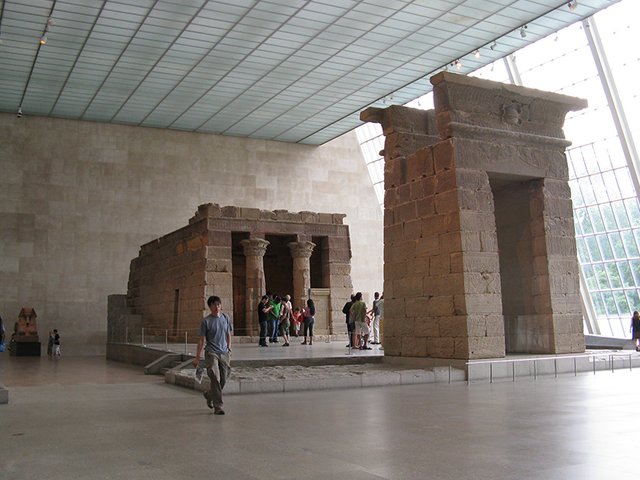
The primary function of the Temple of Dendur was as a place of ritual and sacrifice, designed to maintain the Ma’at (divine order) and ensure the annual flooding of the Nile. It served as a localized religious hub where the community could interact with the divine through the mediation of the Emperor-Priest. Beyond its spiritual utility, the temple was a political statement. By building a traditional temple, Augustus positioned himself as a legitimate successor to the Pharaohs, using religious architecture to stabilize a volatile border region and pacify the local population. It was a space where the cosmic and the political merged, anchored by the eternal presence of the goddess Isis.

The salvation and modern “excavation” of the temple were made possible by the UNESCO International Campaign to Save the Monuments of Nubia. Between 1964 and 1966, the temple was dismantled block by block under the supervision of the Egyptian Antiquities Service to prevent its submersion. In 1965, the Arab Republic of Egypt gifted the temple to the United States in recognition of the financial and technical ᴀssistance provided during the Nubian salvage project. The Metropolitan Museum of Art in New York was selected to house the relic, where it was meticulously reᴀssembled in the Sackler Wing in 1978. Today, it remains one of the few ancient Egyptian temples that can be viewed in its entirety outside of Egypt, maintained by a dedicated team of curators and conservators.
✓ hoangduc
The Temple of Dendur is a magnificent example of Roman-era Egyptian architecture, originally situated on the left bank of the Nile River in Lower Nubia, approximately 80…