The Unfinished Obelisk: A Lithic Blueprint of New Kingdom Ambition
The monument depicted in the aerial image is the Unfinished Obelisk, an unprecedented feat of ancient engineering located in the northern region of the Aswan stone quarries in Egypt. This mᴀssive artifact dates to the 18th Dynasty of the New Kingdom (c. 1473–1458 BCE), during the prosperous reign of Queen Hatshepsut. It was intended to be the largest obelisk ever raised in antiquity, commissioned to stand at the entrance of the Temple of Karnak in Thebes. This era represents the peak of Egyptian architectural grandiosity, a time when the pharaohs sought to manifest their divine right to rule through the extraction of colossal, single-block monuments that served as permanent solar symbols and ideological anchors for the state.
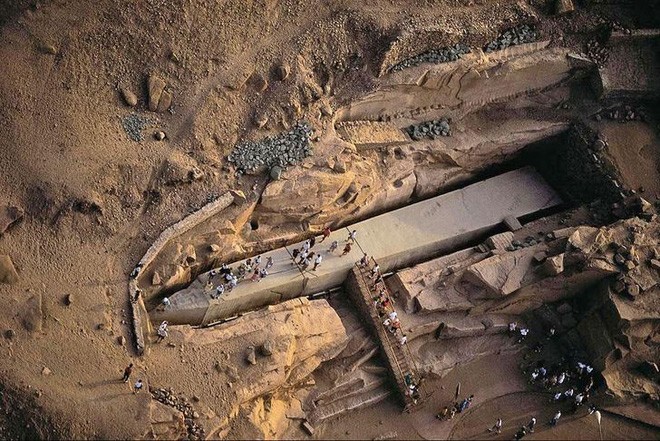
While the quarries of Aswan have been known since antiquity, the scientific “discovery” and systematic clearance of the Unfinished Obelisk was conducted by the British archaeologist Reginald Engelbach in 1922. Working for the Egyptian Antiquities Service, Engelbach meticulously removed centuries of accumulated sand and debris to reveal the full 42-meter length of the stone. His findings provided the first empirical evidence for how the ancient Egyptians actually quarried granite. Today, the site is managed by the Ministry of Tourism and Antiquities of Egypt and is a key component of the UNESCO World Heritage area of Aswan. Ongoing research at the site, involving international teams and modern non-invasive technologies, continues to map the surrounding industrial landscape, revealing the vast support networks required to sustain such a mᴀssive workforce.
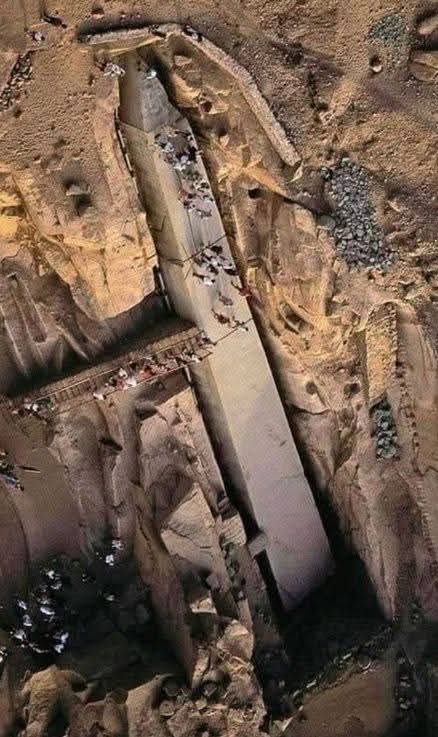
The obelisk is carved from Aswan pink granite, a volcanic rock prized for its hardness and aesthetic beauty. The craftsmanship involved is a masterclass in subtractive engineering. Rather than using iron chisels—which were not yet hard enough for granite—ancient workers used dolerite pounders (hand-sized stones of a harder volcanic rock). Laborers stood in rows and pounded the rock continuously to create vertical trenches around the obelisk’s perimeter, as seen in the image. The discovery of fire-blackened areas suggests that thermal shock (heating the stone and then cooling it rapidly with water) may have also been used to weaken the rock. The obelisk was ultimately abandoned when a mᴀssive diagonal crack appeared in the stone; however, for archaeologists, this failure is a blessing, as it preserved the “frozen” intermediate stages of quarrying that are usually erased in finished monuments.

In terms of utility, the obelisk was designed as a solar monument (tekhen). Its pyramidal tip, or benben, was intended to be covered in electrum (an alloy of gold and silver) to catch the first rays of the morning sun, reflecting the light across the Nile Valley. Obelisks were not merely decorative; they were ritual devices meant to channel the life-giving energy of the sun god Ra into the temple complex. Had it been completed, this obelisk would have stood 42 meters high and weighed nearly 1,200 tons. Its sheer size was a political statement, intended to dwarf the monuments of Hatshepsut’s predecessors and cement her legacy as a ruler favored by Amun-Ra. The abandonment of the project signifies the risk inherent in ancient mega-projects, where the physical flaws of the earth could halt even the most powerful queen’s ambitions.
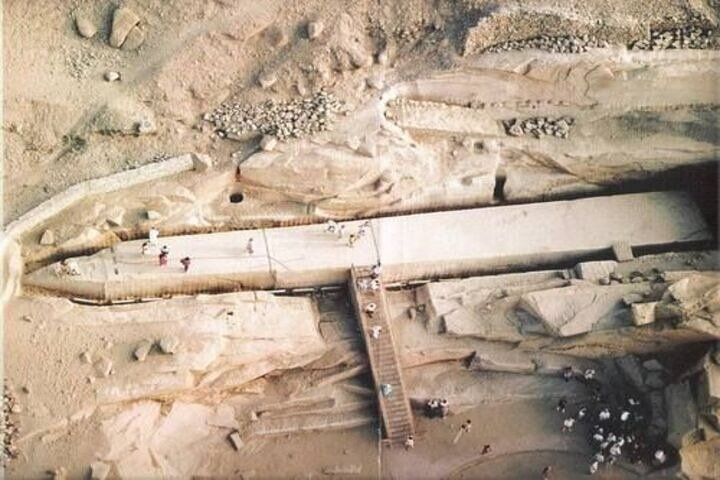
The Unfinished Obelisk remains the world’s most important site for the study of ancient Egyptian technology and logistics. It provides a definitive answer to the “how” of Egyptian masonry, moving beyond speculation to provide physical proof of the labor-intensive pounding method. For modern engineers, the site offers insights into ancient crack propagation and the physical limits of stone as a building material. Today, the quarry is an open-air museum that attracts scholars from around the globe. It stands as a poignant reminder of the fragility of human ambition; though it never reached its destination at Karnak, the Unfinished Obelisk has served a greater purpose in the modern era as a lithic textbook, teaching us more about the minds and hands of the ancient builders than any finished monument ever could.
✓ Team
The monument depicted in the aerial image is the Unfinished Obelisk, an unprecedented feat of ancient engineering located in the northern region of the Aswan stone quarries…