The Vertical Sanctuary: Abuna Yemata Guh and the Monolithic Faith of the Gheralta Highlands
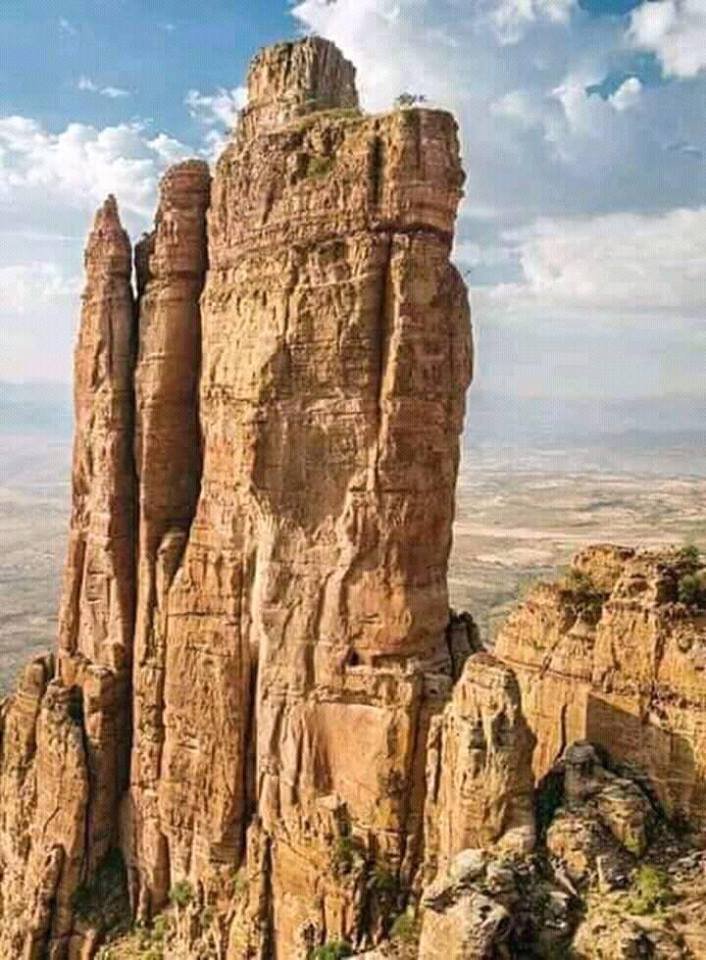
Perched precariously atop a 250-meter sandstone pinnacle in the Gheralta region of Tigray, Ethiopia, the church of Abuna Yemata Guh stands as one of the most physically challenging and spiritually evocative archaeological sites in the world. Traditionally dated to the 5th or 6th century AD, the church is attributed to Abuna Yemata, one of the “Nine Saints” who traveled from the Byzantine Empire to spread Christianity in the Aksumite Kingdom. This era was a transformative period for the Horn of Africa, as it solidified Ethiopia’s status as one of the oldest Christian nations. The choice of such an inaccessible location was likely driven by a dual need: the desire for solitary, ascetic meditation and the practical necessity of defense against invading forces during turbulent centuries.
Discovery and Insтιтutional Research While the church has remained an active site of pilgrimage and local worship for over 1,500 years, its systematic documentation by the global archaeological community began in the mid-20th century. Early architectural surveys were conducted by the British Insтιтute in Eastern Africa and later by the Ethiopian Authority for Research and Conservation of Cultural Heritage (ARCCH). In the late 1960s, researchers like Georg Gerster brought international attention to the site through aerial pH๏τography. More recently, teams of conservators and art historians have worked to document the site using 3D laser scanning to analyze the structural integrity of the sandstone pillar and the preservation of its unique interior, ensuring that this “church in the sky” is protected from the environmental pressures of the 21st century.
Material Composition and Lithic Engineering The church is a masterpiece of monolithic rock-cut architecture, carved directly into Enticho Sandstone. Unlike traditional construction, no materials were brought to the site; instead, the space was created through “subtractive” engineering. Masons hollowed out the interior of the spire to create a cruciform plan, featuring a small narthex and a domed sanctuary. The walls and ceilings were then smoothed to create a canvas for religious art. The physical approach to the church—a near-vertical climb requiring hand-over-hand scaling of the rock face—is an integral part of its architectural design, functioning as a “vertical pilgrimage” where the journey itself serves as a purification of the soul before entering the sacred space.
Iconographic Details and Artistic Craftsmanship The interior of Abuna Yemata Guh, as highlighted in the circular inset of image_d16abc.jpg, contains some of the best-preserved orthodox frescoes in Sub-Saharan Africa. These paintings, executed in a palette of ochre, charcoal, and mineral pigments, date primarily to the 15th century, though they likely cover older layers. The iconography depicts the Nine Saints, the Apostles, and various biblical figures characterized by large, expressive eyes and intricate geometric borders. The dry, stable atmosphere of the high-alтιтude cave has acted as a natural preservative, keeping the colors vibrant for centuries. The ceiling is particularly notable for its sophisticated use of interlaced knots and circular medallions, reflecting a local stylistic evolution of Byzantine and Coptic artistic traditions.

Significance and Functional Continuity The enduring significance of Abuna Yemata Guh lies in its unbroken functional continuity. Unlike many archaeological sites that exist as abandoned ruins, this church remains a vibrant center of faith. It serves as a local parish where parents carry infants up the cliff face for baptism and where the deceased are brought for their final rites. Archaeologically, the site provides a rare window into the Aksumite and post-Aksumite transition, demonstrating how religious architecture can adapt to extreme topography. It stands as a monument to human resilience and the profound intersection of geology and divinity, proving that for the faithful of the Gheralta, the highest peaks were the closest points of contact with the heavens.
✓ hoangduc
Perched precariously atop a 250-meter sandstone pinnacle in the Gheralta region of Tigray, Ethiopia, the church of Abuna Yemata Guh stands as one of the most physically…