The Vix Krater: A Colossal Masterpiece of Archaic Greek Bronzework
From a formal archaeological perspective, the Vix Krater represents the most significant discovery of a Mediterranean import in Iron Age Europe. Uncovered in 1953, the artifact was the centerpiece of a magnificent “princely burial” belonging to a high-status Celtic woman, often referred to as the “Lady of Vix.” The krater was found in a primary funerary context, situated within a large wooden chamber beneath a tumulus. Its presence in northern Burgundy, thousands of kilometers from its likely origin in Magna Graecia (Southern Italy) or Sparta, provides critical stratigraphic evidence of the vast, sophisticated trade networks that existed between the Hallstatt culture and the Mediterranean world during the 6th century BCE.

The “materiality” of this artifact consists of high-quality bronze, an alloy primarily of copper and tin. The “craftsmanship” is a pinnacle of ancient Greek metallurgy. The body of the krater was created using the “sphyrelaton” technique—hammering a single, mᴀssive sheet of bronze into its bulbous shape—which is an extraordinary feat given its height of 1.64 meters. The decorative elements, including the heavy volute handles and the frieze of chariots and warriors, were cast separately using the “lost-wax” (cire perdue) process and subsequently riveted to the body. This combination of cold-hammering and precision casting allowed the artisans to create a vessel with a capacity of 1,100 liters, making it the largest known bronze vessel from antiquity.

The morphology of the vessel is that of a “Volute Krater,” characterized by its scrolled handles that rise above the rim. The decorative frieze running around the neck is of immense interest to iconographers; it depicts a procession of Greek hoplites (infantry) and four-horse chariots (quadrigas). A key morphological feature is the handles, which are adorned with the grotesque faces of Gorgons—mythical creatures with snake-hair intended to ward off evil. The lid of the krater is equally intricate, topped with a small, delicate bronze statuette of a female figure wearing a peplos. These details confirm the vessel’s origin in a top-tier Greek workshop, likely in the colonies of Southern Italy.
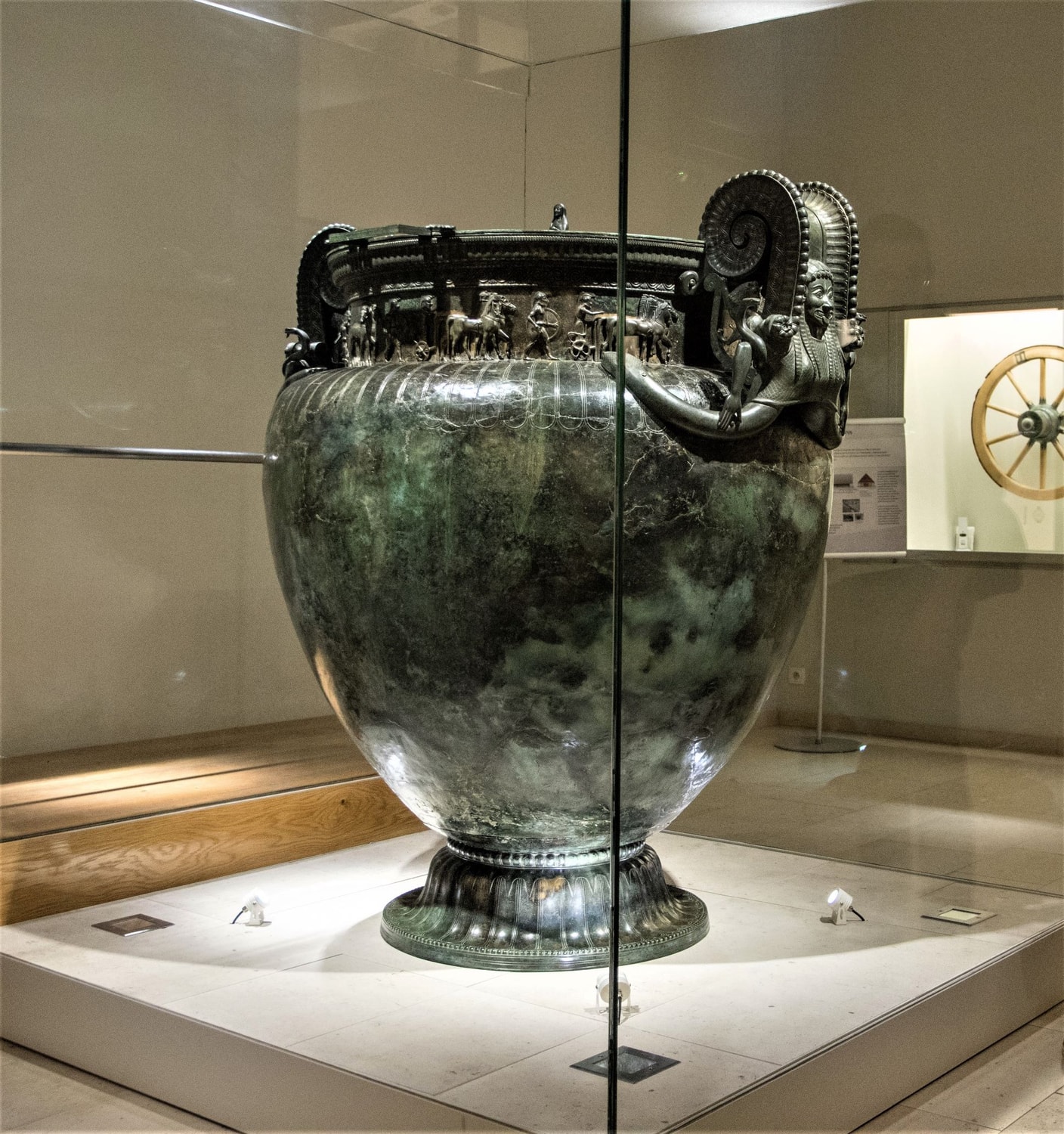
The primary function of a krater in the Greek world was for mixing wine with water during a symposium (aristocratic drinking party). However, its “utility” in the Celtic context of Vix was significantly different. For the Lady of Vix, this vessel was a “prestige artifact,” a physical manifestation of her political power and her ability to control the trade of luxury goods like tin and amber. Its sheer scale rendered it impractical for daily use; instead, it served a ceremonial and funerary purpose. By possessing such an object, the Celtic elite signaled their participation in the prestigious “drinking culture” of the Mediterranean, using foreign luxury to solidify their domestic social hierarchy.

The discovery was made by local amateur archaeologist Maurice Moisson and subsequently excavated by René Joffroy, who was then the director of the Museum of Châtillon-sur-Seine. The meticulous recovery of the krater allowed researchers to observe how it had been crushed by the collapse of the tomb’s roof, requiring extensive restoration. Today, the Vix Krater is the crown jewel of the Musée du Pays Châtillonnais in France. Ongoing research by the French National Center for Scientific Research (CNRS) utilizes modern chemical analysis of the bronze to pinpoint the exact copper mines used, continuing to unravel the complex history of this ancient “ambᴀssador” between two great civilizations.
✓ hoangduc
From a formal archaeological perspective, the Vix Krater represents the most significant discovery of a Mediterranean import in Iron Age Europe. Uncovered in 1953, the artifact was…