The Weaver of the Nordic Sun: Unlocking the Sartorial Enigma of the Egtved Girl
Deep within the damp, acidic embrace of a Jutland barrow, where the Danish mists have preserved the silent choreography of the Bronze Age for over three millennia, an extraordinary archaeological relic continues to defy the ravages of time. Unearthed near the hamlet of Egtved in 1921 and cataloged under archive reference C-12409, the hollowed-out oak log coffin sealed away a micro-environment of absolute darkness and chemical preservation, locking in the fragile organic remnants of a young woman who walked the earth around 1370 BCE. Archaeological reports from the National Museum of Denmark detail a burial context untouched by predatory grave-robbers, where the unique tannin-rich sludge acted as a preservative shroud, keeping intact not merely bones, but a breathtaking textile ensemble that bridges the profound chasm between abstract historical periods and the intimate reality of an individual human life. This stunning preservation offers modern researchers a rare, unblemished window into the sartorial brilliance and complex socio-economic networks of the Nordic Bronze Age, transforming a simple mound of earth into an epic archive of human expression.
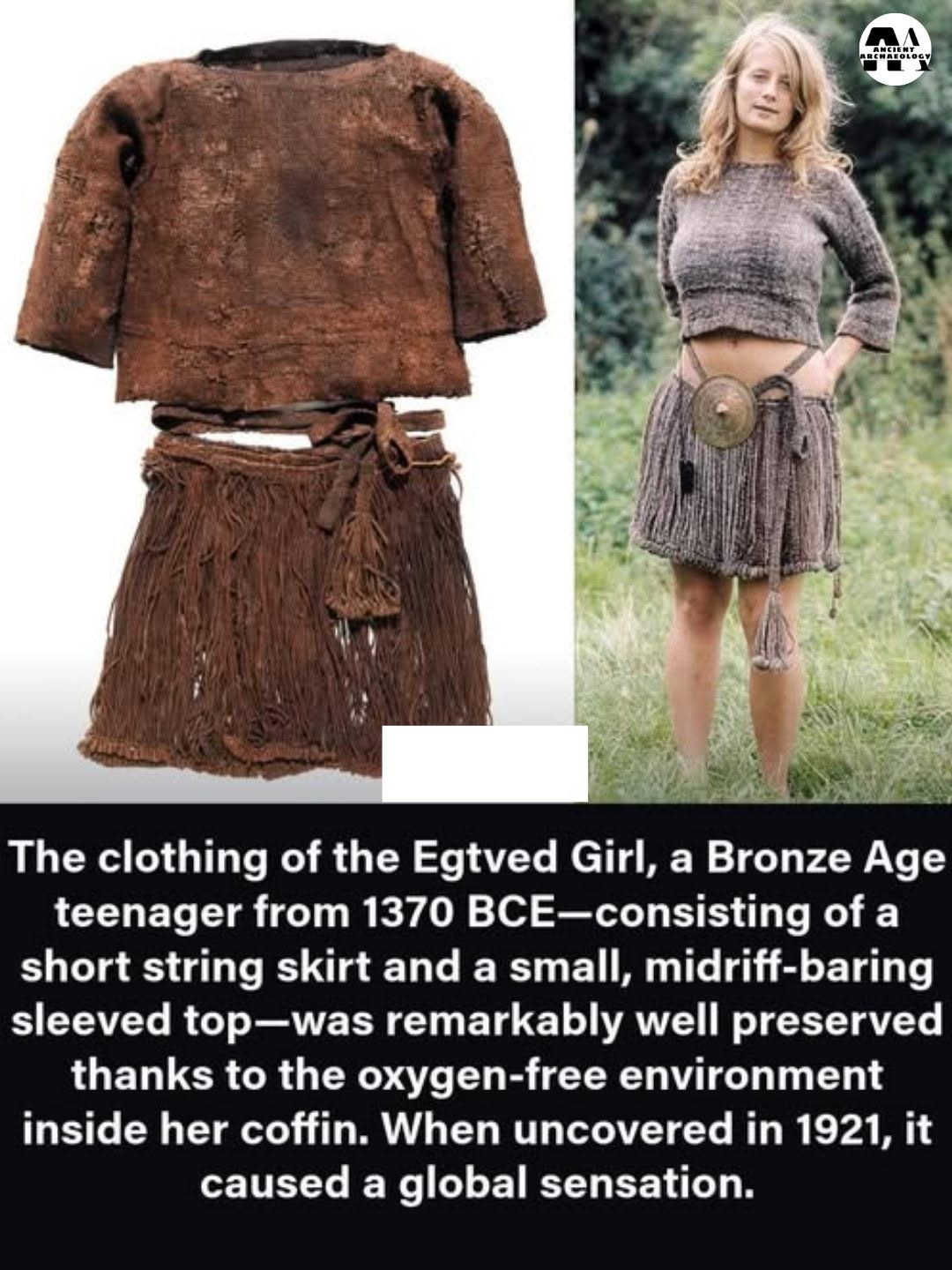
The physical centerpiece of this discovery is an exquisitely tailored costume that challenges every simplistic notion of primitive prehistoric craftsmanship. The ensemble consists of a short-sleeved, structurally sophisticated woolen blouse woven with fine-spun yarn, paired with a knee-length string skirt constructed from heavy, meticulously twisted woolen cords hanging loosely from a waistband. Complementing these garments is a heavy bronze belt plate adorned with intricate concentric spirals and solar iconography, a motif deeply tied to the pan-European Bronze Age cosmology of light and seasonal rebirth. Textile analysis conducted via scanning electron microscopy reveals advanced spinning and weaving techniques that required specialized knowledge, multi-stage wool preparation, and a sophisticated understanding of natural dye extraction from local flora such as woad and madder. Far from being crude coverings meant merely for warmth, these garments represent a high-status sartorial expression, signaling both the wearer’s elevated position within her community and the refined aesthetic ambitions of a culture deeply attuned to the rhythms of the natural world.
To fully comprehend the significance of this textile ensemble, one must trace the extensive commercial and cultural lifelines that sustained the Jutland communities during the middle of the second millennium BCE. Strontium isotope ᴀssays performed on the young woman’s hair and teeth reveal an astonishing biographical narrative: she was not a native of the Egtved valley, but originated hundreds of kilometers away, likely in the Black Forest region of modern-day Germany or perhaps even further south. This migratory trajectory proves that the Nordic Bronze Age was characterized by vast, highly active networks of long-distance exchange, wherein amber from the Baltic shores was traded southward in exchange for bronze metallurgy, fine woolens, and elite marriage alliances that bound distant tribal confederacies together. The Egtved clothing thus becomes a physical manifestation of this mobility—a stylistic hybrid reflecting a mobile aristocracy whose women moved freely across cultural frontiers, carrying with them distinctive weaving traditions, ritual knowledge, and diplomatic prestige that cemented alliances across thousands of miles of wilderness and sea.

Ultimately, the enduring mystery of the Egtved Girl transcends the technical brilliance of her garments, anchoring itself deeply in the philosophical weight of what her preserved presence communicates across thirty-four centuries. In a historical epoch typically dominated by the impersonal debris of bronze axes, stone cairns, and fragmented weaponry, this fragile preservation restores a deeply human pulse to the archaeological record, allowing us to perceive the individual heartbeat beneath the weight of historical time. Her carefully curated burial, accompanied by the cremated remains of a child and offerings of yarrow flowers, speaks of a community grappling with loss through sacred ritual, projecting their hopes into the eternal cycle of the seasons. As contemporary molecular archaeology and textile science continue to interrogate these ancient fibers, the silent sentinel of Jutland reminds us that history is not merely a chronicle of empires and metal, but a delicate, unbroken thread spun from the lives, journeys, and artistry of ordinary human beings who dared to adorn themselves against the dark.

✓ Alex Morgan
Deep within the damp, acidic embrace of a Jutland barrow, where the Danish mists have preserved the silent choreography of the Bronze Age for over three millennia,…