The Zoomorphic Monoliths of Quiriguá: Deciphering the Stone Arcana of the Maya
The monumental sandstone carvings of Quiriguá, an ancient Maya site located in the lower Motagua River valley of eastern Guatemala, represent a unique pinnacle of Pre-Columbian artistic and epigraphic expression. While the site flourished throughout the Classic Period, the specific megalithic masterpieces shown—known as Zoomorphs—date to the late 8th century CE (c. 785–805 CE). Specifically, Zoomorph P, one of the most famous and complex among them, was dedicated in 795 CE by the ruler “Sky Xul.” These mᴀssive, rounded boulders differ significantly from the vertical stelae found elsewhere in the Maya world; they are horizontal, multi-ton blocks entirely covered in intricate low-relief carvings that blend human portraiture, mythological creatures, and dense hieroglyphic texts. This era marked Quiriguá’s golden age of independence, following its victory over the rival city of Copán, leading to a stylistic explosion where stone was treated as a malleable medium for royal propaganda and cosmological storytelling.

The material used for these gargantuan monuments is a hard reddish-brown sandstone, sourced from the nearby Sierra de las Minas mountains. Unlike the limestone used at Tikal or Palenque, this sandstone allowed Quiriguá’s sculptors to achieve incredible depth and durability, though it was significantly more difficult to carve. The process of creation was an arduous feat of engineering and artistry: once the mᴀssive boulders—some weighing over 20 metric tons—were transported to the ceremonial Great Plaza, artists used chert and obsidian chisels along with basalt hammers to peck away the stone. Every square inch of the surface was utilized, employing a technique known as horror vacui (fear of empty space). The carvers managed to wrap a continuous narrative around the undulating surfaces of the natural boulder, meticulously smoothing the finish with sand and water to ensure that the delicate glyphic “cartouches” remained legible for centuries against the tropical humidity.
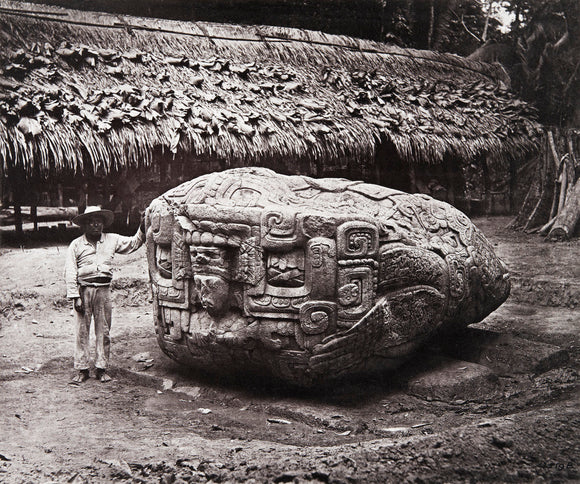
Architecturally and symbolically, these Zoomorphs functioned as terrestrial embodiments of the Maya cosmos. They typically depict a “Cosmic Monster” or a “Celestial Turtle,” from whose jaws a royal figure—often a ruler or a deity—emerges. This imagery symbolizes the portal between the earthly realm and the underworld (Xibalba), positioning the King as the central axis of the universe and the mediator of divine will. On Zoomorph P, the ruler “Sky Xul” is depicted seated in a ceremonial niche, surrounded by an “earth-monster” motif. Beyond their religious significance, the stones served as permanent historical archives. The dense hieroglyphic inscriptions carved into the sides of the boulders record precise calendrical dates (using the Long Count system), royal successions, and the ritual bloodletting ceremonies performed to ensure the fertility of the land and the stability of time itself.
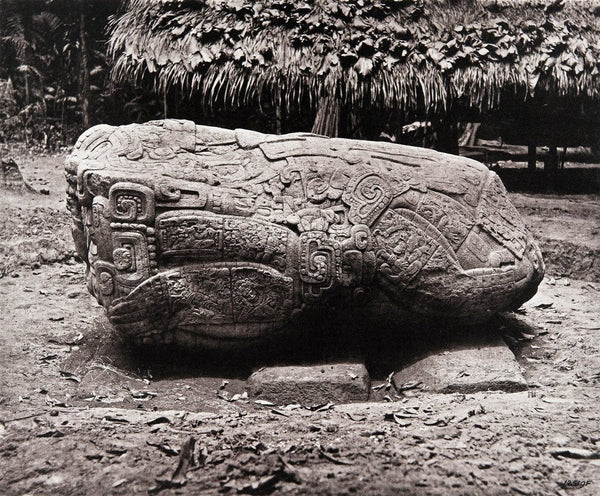
The modern rediscovery and scientific documentation of these monuments were spearheaded by the pioneering British explorer and archaeologist Alfred Percival Maudslay in the 1880s and 1890s. Maudslay’s work was revolutionary for its time; he was among the first to use high-quality large-plate pH๏τography and plaster casting to preserve the details of the decaying monuments. By covering the boulders in paper-mache and plaster, he created “molds” that were shipped back to the British Museum, allowing scholars in Europe to decipher Maya glyphs without damaging the originals. Later, in the early 20th century (c. 1910–1934), the School of American Archaeology (now the School for Advanced Research) and the Carnegie Insтιтution of Washington, led by figures like Sylvanus Morley, conducted further excavations to clear the jungle growth and stabilize the site, which had been partially buried by river silt from centuries of flooding.
Today, the Zoomorphs of Quiriguá are recognized as a UNESCO World Heritage site, standing as the most sophisticated examples of three-dimensional Maya sculpture in existence. While the forest once threatened to reclaim these stones, they remain in their original positions in the Great Plaza, serving as a testament to a civilization that viewed stone not merely as a building material, but as a living record of their idenтιтy. The interplay of myth and history on the surface of these boulders continues to provide archaeologists with critical data regarding Maya political alliances and their advanced astronomical knowledge. As one gazes at the weathered faces emerging from the stone, it is clear that the craftsmen of Quiriguá intended for their kings to speak across the millennium, using the permanence of the Motagua sandstone to defy the transience of human life.
✓ hoangduc
The monumental sandstone carvings of Quiriguá, an ancient Maya site located in the lower Motagua River valley of eastern Guatemala, represent a unique pinnacle of Pre-Columbian artistic…