Unearthing the Ancient Lithic Landscapes: The Quarries of Cusa
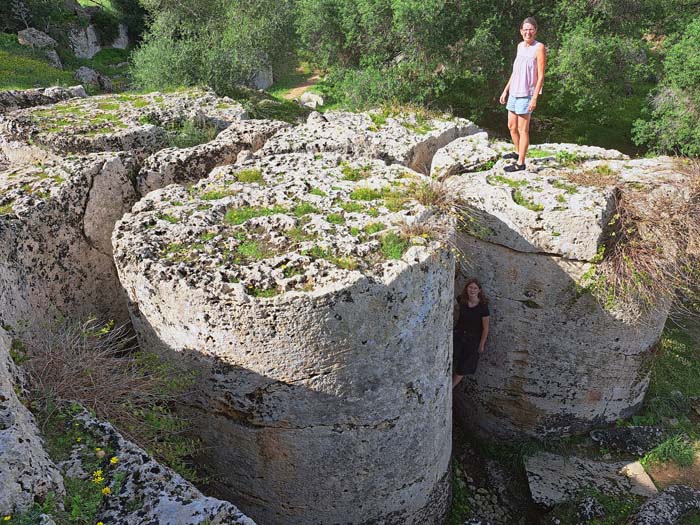
The remarkable archaeological site depicted is the ancient quarry of Cusa, situated in modern-day Sicily, Italy. This site, which dates back primarily to the 6th and 5th centuries BCE, provides an unparalleled window into the industrial capabilities of the Greek colony of Selinus (Selinunte). The quarry is renowned for its abandoned, partially extracted stone drums, which remain in the exact state they were left by ancient workmen thousands of years ago, offering a frozen, tangible moment of history. The discovery of such sites has been fundamental for archaeologists in mapping the logistical chain of ancient monumental construction, as Cusa was the primary source of the mᴀssive limestone blocks used for the temples of Selinus.

The material of the quarry is a durable, golden-hued calcarenite—a type of porous limestone—which was highly prized for its structural integrity and relative ease of carving. The fabrication process evidenced reveals a sophisticated and systematic approach to extraction. Workmen would carve deep, circular trenches into the bedrock, isolating the cylindrical column drums while still attached to the base. Once the circumference was fully cut, wedges were inserted and driven into the lower sections to fracture the block from the bedrock. This technique, though labor-intensive, required high mathematical precision to ensure that these mᴀssive, multi-ton components could be extracted without cracking, showcasing the advanced engineering acumen of the ancient Mediterranean world.

Regarding the function and significance, these abandoned drums were not simply discarded waste, but rather provide a critical record of ancient manufacturing delays and site abandonment. The sudden interruption of work at Cusa is widely attributed to the Carthaginian invasion and destruction of Selinus in 409 BCE, which left the quarry and its mᴀssive, half-finished columns permanently frozen in time. These remnants serve as an unintentional time capsule, illustrating that these monumental architectural pieces were intended to be transported as singular, heavy components from the quarry to the temple site, a feat of transportation that would have required mᴀssive mobilization of human labor and specialized timber-frame carts.
Archaeological interest in the quarries of Cusa has been long-standing, with early survey work and documentation undertaken by various European scholars during the 18th and 19th centuries who sought to connect the abandoned stone cylinders to the incomplete temples at the archaeological park of Selinunte. More contemporary studies have been spearheaded by insтιтutions such as the German Archaeological Insтιтute, which has utilized modern pH๏τogrammetry and topographic mapping to analyze the extraction patterns. By meticulously studying the marks left by the chisels and the depth of the circular cuts, researchers have been able to reconstruct the specific tools and workforce organization required for such large-scale production, moving our understanding of the site from simple ruins to a complex industrial factory.
Ultimately, the site shown is far more than a collection of broken stones; it is a profound testament to the scale and ambition of Greek colonial society in Sicily. By preserving these colossal elements in their original environment, Cusa allows contemporary observers to grasp the sheer physical weight of ancient architectural ambition. Each drum, shaped and then left behind in the silent landscape, speaks to the fragile nature of civilization and the abrupt shifts in history that halted the progress of these monumental religious structures. As a protected archaeological area, Cusa remains a vital field site that continues to challenge our ᴀssumptions about ancient logistical prowess and the profound human impact on the natural environment.
✓ hoangduc
The remarkable archaeological site depicted is the ancient quarry of Cusa, situated in modern-day Sicily, Italy. This site, which dates back primarily to the 6th and 5th…