Unveiling Britannia’s Bulwark: An Archaeological Analysis of the Construction and Legacy of Hadrian’s Wall
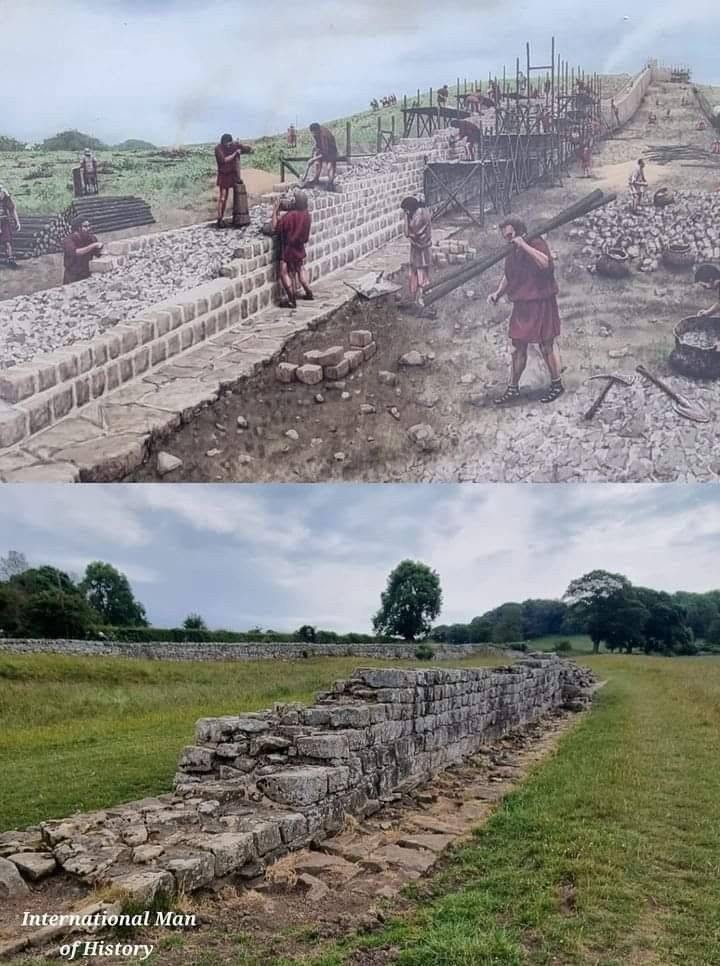
Hadrian’s Wall, a monumental feat of Roman military engineering, stands as the most significant physical remnant of the Roman occupation of Britain. Commissioned by the Emperor Hadrian following his visit to the province around 122 CE, the wall’s construction is precisely dated to the early 2nd century. As illustrated by the meticulous reconstruction scene in the upper panel, this undertaking required the mobilization of legions across the entire width of the island, starting from the Tyne estuary in the east to the Solway Firth in the west. It was not built as a static defense, but as a complex, controlled frontier zone designed to regulate movement, project power, and separate the Romanized south from the unconquered tribes to the north. The sheer scale of the project marks a significant shift in Roman frontier policy from expansion to consolidation.

The frontier stretches for approximately 80 Roman miles (73.5 miles or 118 km) across the rugged terrain of Northern England. The choice of route was strategic, often utilizing the natural ridge of the Whin Sill escarpment, which provided a natural defensive advantage, particularly along the central crags where the wall clings dramatically to the cliff edge, as seen in the landscap The wall did not exist in isolation; it integrated with a mᴀssive infrastructure of milecastles (fortlets every Roman mile), turrets (signaling posts between milecastles), and larger auxiliary forts positioned strategically along or just behind its line. To the north lay the vallum, a vast defensive earthwork consisting of a central ditch and mounds, creating a clear “no-go” exclusion zone.
The construction methods, vividly depicted in the upper panel, reveal a high degree of Roman engineering skill and logistical organization. The wall was primarily constructed of stone, a departure from the earlier practice of earth and timber ramparts. The main structure consisted of two facing walls of cut sandstone blocks (the facings) with a rubble-and-mortar core known as opus caementicium. This technique created an incredibly durable and resilient structure. The upper portion of illustrates legions, identifiable by their segmented armor (lorica segmentata) and tunics, engaged in various tasks: quarrying stone, mixing mortar (using a trough and pole), and laying the course work. The scaffolding suggests the wall’s considerable height, estimated to have been between 3.5 and 6 meters, depending on the sector.
While the wall itself is the primary “artefact,” countless smaller objects discovered during excavations in its milecastles and forts provide intimate details of the lives of the soldiers who manned it. These include armor components like the copper-alloy cheek piece from a cavalry helmet, gaming pieces made of bone or glᴀss, intricate fibulae (brooches), and countless iron tools. Many of these items show evidence of local fabrication by legionary craftsmen, suggesting a degree of self-sufficiency within the fort communities. The sheer volume of construction stone, transported from local quarries, and the vast quanтιтies of iron nails, tools, and lead used for sealing joints, speak to a mᴀssive and coordinated industrial effort that stretched the capabilities of the Roman military-industrial complex in Britannia.
Hadrian’s Wall is far more than a ruined fortification; it is a globally recognized archaeological landscape and a UNESCO World Heritage Site. Its significance lies not only in its architectural grandeur but also in what it reveals about Roman frontier administration, military life, and cultural interaction. The scientific study of the wall began in earnest in the 19th century, pioneered by figures like John Collingwood Bruce, whose 1851 work, “The Roman Wall,” remains a foundational text. Modern archaeology, through excavation and non-destructive techniques like geophysical survey, continues to refine our understanding, revealing new phases of construction, the daily routines of the garrison, and the environmental impact of such a mᴀssive structure on the ancient landscape. Contrasting a reconstruction with the reality of the remaining ruin, underscores the enduring physical presence and historical importance of Britannia’s great bulwark.
✓ hoangduc
Hadrian’s Wall, a monumental feat of Roman military engineering, stands as the most significant physical remnant of the Roman occupation of Britain. Commissioned by the Emperor Hadrian…